Cowboy Woody: Still a Jerk?

Many have now seen an early test screening of the original Toy Story, in which the protagonist Woody is depicted as far more cruel and callous than his eventual canonical self:

It certainly seems like a jarring departure from the Tom Hanks-voiced character who later appeared in many sequels (the latest set to release tomorrow) and became a cultural icon alongside costar Buzz Lightyear. But is his final version really so admirable?

Let’s recount his actions towards the end of the first installment (spoilers, obviously). He and Buzz are held captive by Sid, notorious for altering and destroying his toys in various ways — unaware of the fact that in the Toy Story universe, they are all actually alive, but always appear inanimate in the presence of flesh-and-blood humans. When Sid is about to get Buzz annihilated by strapping him to a model rocket, Woody rescues him by enlisting the help of Sid’s other toys, dropping all pretenses of inanimateness in front of Sid, and warning him to treat his toys better, sending him running off screaming.

A heroic act, right? But let’s examine his actions further.

I haven’t seen the fourth movie and don’t plan on seeing the fifth — as far as I can tell, the first three comprise a perfect trilogy that doesn’t need to be expounded upon any further. But assuming Toy Story 4 and 5 don’t explore the underlying lore any more than the others, the audience is not very privy to the reasons behind the toys’ charade. The closest we get to a backstory is Woody’s mention that his plan would “break a few rules.”

What rules? Who made them and when? We don’t know. All we do know is how sacrosanct and immutable they are to seemingly every toy in existence.

Consider all the toys that Sid had destroyed prior to Woody’s intervention. Logically, they could have at any time revealed themselves in an effort to be spared: “Wait! Stop! I’m alive! I’m conscious! I’m self-aware! I’m sentient! I can feel pain! I don’t want to die! Please don’t do this!” But no, each and every one of them accepted their fate, preferring to sacrifice their life rather than violate this universal code.

And then comes Woody, who apparently thinks nothing of it.

One must wonder: What would all those destroyed toys have thought about Woody flippantly throwing the Toy Code to the wayside in order to rescue his friend from the same fate they’ve suffered? About Sid’s other toys — their friends, cohorts, and essentially family members — offering their assistance?

And Woody’s intentions notwithstanding, what would happen if more toys shared his flexibility with the rules, and abandoned them for the sake of rescuing one of their own? Perhaps most humans witnessing the toys’ true nature would keep quiet about it out of belief they were hallucinating or fear they would be seen as insane. But surely some the-Emperor-is-naked types will go to the press about it, and more and more will corroborate their claims, and eventually the secret will be out and warlords will order massive “toys” ten feet tall with several limbs for wielding massive weapons to be built to serve as their armies. (At least, that’s what would happen given my best guess as to why toys have this code in the first place.)

Woody’s personality may have been softened for the final cut, but closer analysis still reveals his sense of principles to be murky at best. Sid, at the very least, was unaware of the immorality of his actions, but Woody clearly knew about the “rules”… and made the conscious choice to flout them.

On Writing Science Fiction

(Author’s Note: If you have not yet read the short stories in question, you would be well-advised to do so when the links to them appear in this text, before you read any further in this article.)

When I announced the publication of “Blind Date,” one of my short science fiction stories, to social media, one commentator took issue with my classification of it as science fiction: They said the plot device of selective memory erasure was not enough for it to be sci-fi.

I begged to differ, and noted that it depends on one’s definition of science fiction. According to one such definition, the story contains a scientific concept of which the premise is dependent upon to work. Perhaps more specifically, I probably should have noted, the concept in question has not yet been confirmed to exist (e.g., extraterrestrial life), invented (teleportation), or come to fruition (manned interplanetary travel) at the time the story was written.

As there had never been a successful procedure of selective memory erasure when I had written “Blind Date,” and the story would not work with that as a plot device, I am confident it qualifies as science fiction. It’s one of the many narratives I’ve crafted where I introduce a possible future technology, and explore how society and humankind would likely be affected by it.

My inspiration for “As the Founding Fathers Intended,” for example, arose from my noticing how much political discourse in my country was centered around the intentions its founders had for it, many of which people can only speculate about today. What would Benjamin Franklin have said about the state of America today? What did the framers of the Constitution mean by “a well regulated militia”?

And then I thought to myself, what if it were possible for a country to maintain communication with its founders and adjust its policies accordingly? That made for an interesting premise. From there, I determined the means by which this plot would be possible. I considered cryogenic preservation for a while before setting on time dilation caused by space travel at close to the speed of light.

After that, I set out figuring how the rest of this society would function. Would anyone else besides the founders travel on this ship? Immediate family, perhaps? How often would they return to earth? How much power would they have over the current governmental body? What other activities would they partake in during their visit? What formalities and ceremonies would be held? How would their friends and family not on the ship be affected? Would there ever be a complication that prevents the visit from happening?

Finally, when I managed to establish reasonable- and likely-sounding answers to all these questions, I bundled everything into “As the Founding Fathers Intended,” a blend of science fiction and political satire that takes a look at a world where people could get definitive answers on how to run their country in the titular manner.

The creative process behind “Blind Date” was similar. I was pondering stories I’ve read about couples who met each other because of mass shootings and terrorist attacks, and how it must be awkward for them to live with such knowledge. From there, I thought, is there a way for them to fix this predicament, now or in the future? So I considered the possibility of selective memory erasure.

It wasn’t as complex a system as the one surrounding the plot of “As the Founding Fathers Intended,” because it didn’t need to be to address the problem in question. But it still dealt with a scientific concept that had yet to come to fruition at the time when it was written, so I have no doubt the story could be classified as science fiction.

I’m proud of “Blind Date,” particularly because it exemplifies the ability of fiction to tread where reality cannot. Even if everyone thinks to themselves how uneasy one might feel having met their romantic partner only because of a violent attack, it’s not as if society would permit them to discuss such a matter openly, especially with the people in question themselves (“Say, did you ever think about how…”). But fiction offers a refuge in which these matters can be explored, and science fiction allows for a far greater scope of hypothetical situations with which these matters can intersect.

Of course, not all technologies key to a sci-fi premise have to be a pipe dream. It could be something regarded by experts as inevitable and imminent, such as the present day’s relationship with the prospect of vast improvements in artificial intelligence. How will we cope with a reality where art and literature produced by machines outstrips that produced by people? How will the legal system adapt when it’s trivially easy to fabricate photographic and video evidence? Science fiction authors can try their hand at answering such questions before they grow to be truly pressing concerns.

I tried my own hand at tackling such issues with “Short Story Submission,” though the technology central to the story deals with means to counter unwanted use of AI rather than AI itself. Also of note is Alex Proyas’ lambasted adaptation of Asimov’s Robot stories, which for all its faults explored the topic strikingly presciently (albeit accidentally) in its best scene.

There is always the chance that what was science fiction at the time of the work’s writing becomes a reality later on, as was famously the case with many a Jules Verne story. That has yet to come true for any of my stories, but I have found out the hard way that the current understanding and lexicon surrounding science and technology can morph into something that’s not entirely compatible with previously published works of sci-fi. The public conversation about AI is evolving so rapidly that new readers of my novella Realia might not understand a joke it contains about “artificial intelligence,” which at the time of its writing was a term often used to denote the theoretical state of a machine as being conscious, sentient, and self-aware. While a disappointing turn of events for a writer, I suppose it is always a risk to consider when writing science fiction.

Science fiction is a useful genre in that it offers a vision of possibilities. While fiction explores the way things are, science fiction explores how things could be, and prepares humanity for the potential consequences of its actions.

What the Joker Should Have Done in the Climax of The Dark Knight

(Author’s Note: In case you couldn’t tell, this article contains spoilers regarding the climax of The Dark Knight.)

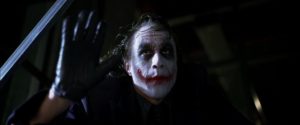
Heath Ledger as the Joker in The Dark Knight (2008)It’s now been fifteen years since the premiere of The Dark Knight, which quickly earned its place as both one of the greatest comic book movies and superhero movies ever, as well as the all-time greatest comic book superhero movie ever. It’s retained those titles with no sign of losing them any time soon, and yet I can’t help but feel the climatic face-off between Batman and the Joker could stand some improvement.

A quick recap of the sequence’s set-up: The Joker has filled two ferries with explosives, and placed the detonator for each ferry’s explosive in the other ferry. He informs the occupants of each ferry that he himself will blow up both ferries after a short amount of time, unless one ferry uses their detonator to blow up the other before then.

The Joker seems to believe that if a detonator is indeed used, it will vindicate his bitter philosophy of everyone willing to sacrifice others in the interests of self-preservation: “When the chips are down, these… ‘civilized people,’ they’ll eat each other.”

It’s certainly satisfying to some degree to see the Joker finally be proven wrong, and to be on the receiving end of one of the most brutal take-the-villain-down-a-peg lines imparted by the hero: “What were you trying to prove? That deep down, everyone’s as ugly as you? You’re alone.”

And yet the moment still doesn’t resonate as much as it should, since it’s questionable about what exactly the Joker was proven wrong. This is because when the scenario he devised faces further scrutiny, it seems doubtful the activation of one of the ferry’s detonators would prove much.

The core problem with the dilemma the Joker has crafted is that he presents the death of at least some people as inevitable — no matter what happens, some people are going to get blown up. Little evidence is shown that any of them have reason to believe Batman will show up to save the day.

Therefore, if anyone actually had used a detonator, they could easily excuse their actions to others and themselves as the needs of the many outweighing the needs of the few. “Look, it was either all of us or some of us. All I did was halve the number of victims.”

Oddly enough, the Joker didn’t need to settle for such an inconsequential “experiment.” He could have easily altered the rules to press its subjects to make a truly questionable decision with pretty much the same materials he had on hand. All he needed to do was take a page from Harvey Dent’s playbook.

Here’s how it would work: Everything prior to the Joker contacting the ferry passengers would remain the same. After informing them of the situation regarding the explosives and detonators, the Joker would flip a coin and cover it. He explains that after a certain amount of time, he will observe the coin. If it landed on heads, he will blow up both ferries. Tails, and he will let everyone go free. If one of the ferries is blown up before then, he will let the surviving passengers go, no matter which side the coin landed on.

And here’s where it gets truly diabolical: Regardless of whether a detonator is used or not, the Joker will announce to the ferries (or ferry) which side the coin had landed on. If people on one ferry opted to blow up the other, and it turned out the coin landed on tails, they will have to live the rest of their lives knowing they essentially killed scores of innocent people for nothing.

The only surefire method of emerging from the scenario unscathed would be to blow up the other ferry, and simply not to care whether it was at all necessary to so. The scheme would punish empathy and reward callousness.

If a ferry blew up with these rules in place, that would serve as a far more damning study of human nature (although still not a scientifically rigorous one). One must wonder why the Joker, who had spent the film demonstrating his tactical cunning, did not think of it.

The blog of author Ulric Alvin Watts